Course Content and Lecturers
Course Content and Lecturers
Social mentoring has emerged as a vital, person-centred, volunteer-driven social intervention across Europe and beyond. This international university short course (non-degree) addresses the need for training and critical reflection in this area. It equips participants with the necessary practical skills and theoretical perspectives to meaningfully engage in inclusive social mentoring practice and related programs.
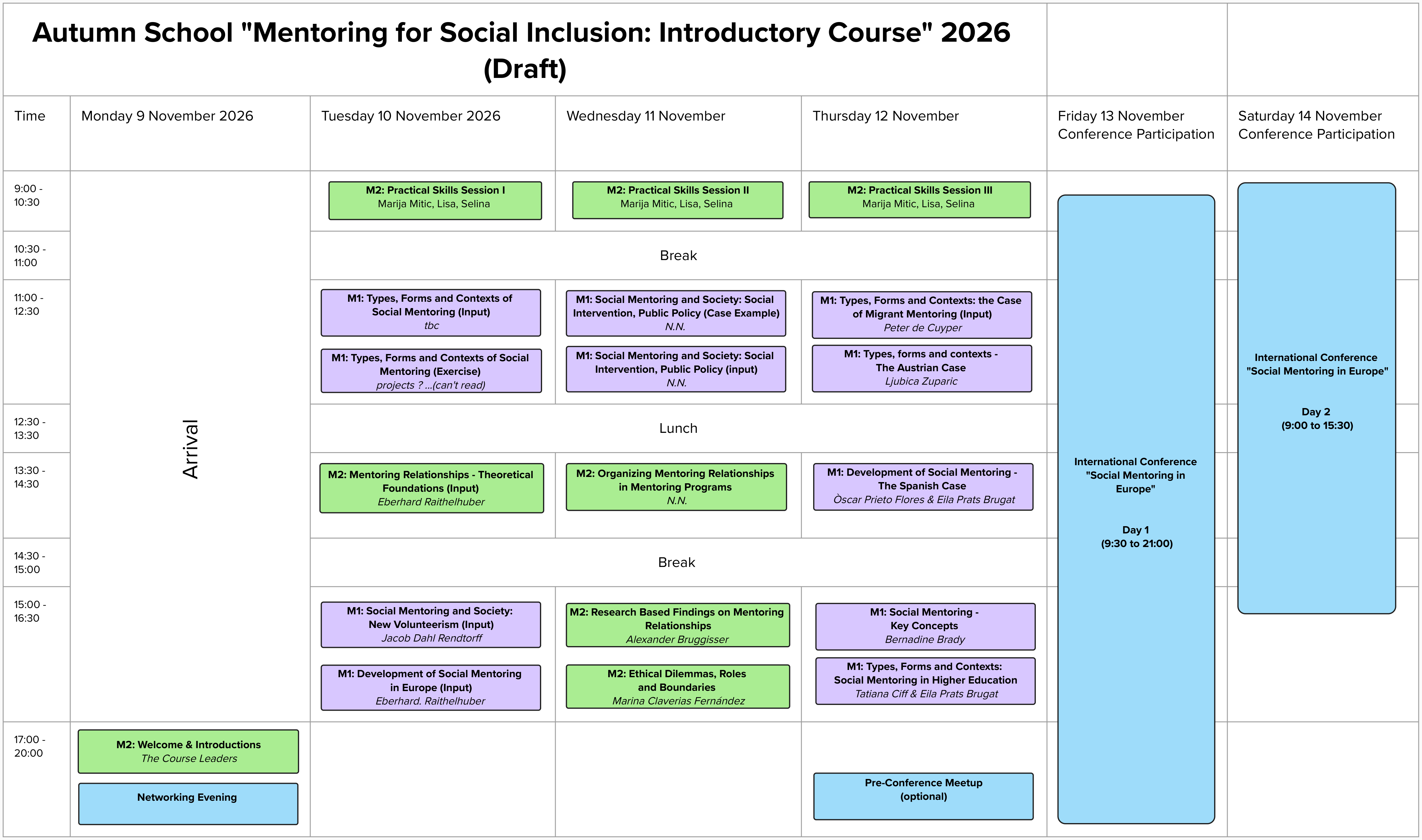
Module 1: Understanding Social Mentoring: Key Concepts
- The development of social mentoring: past, present, and future
- Social mentoring: definitions, objectives, and key concepts
- Types, forms, and contexts of social mentoring
- Social mentoring and society: volunteering, social intervention, and social/public policy
3 ECTS credits (≈ 60% of workload)
Module 2: Nurturing Meaningful Relationships in Social Mentoring
- Building relationships: practical skills and theoretical foundations
- Research-based findings from mentoring programs
- Organizing relationships in mentoring programs: phases of relationship building; exercises based on real case situations
- Ethical dilemmas, roles, and boundaries in mentoring relationships
2 ECTS credits (≈ 40% of workload)

- To build capacity on social mentoring as a growing, volunteer-based form of social Intervention for disadvantaged populations (overall objective)
- To convey a comprehensive understanding of social mentoring at the levels of personal relationships, programmes and policies (main objective of module 1)
- To facilitate theoretical knowledge and practical skills on mentoring relationships across diverse contexts (main objective of module 2)
The lecturers are among Europe’s leading academic experts in social mentoring. Others have many years of experience in managing social mentoring programs and umbrella organizations. In addition to the individuals mentioned, other staff members from participating Erasmus+ partner institutions will also be contributing.
The following contributors have been confirmed so far:
- Alexander Bruggisser, Roskilde University Copenhagen, Denmark
- Dr. Tatiana Ciff, NHL Stenden University of Applied Science, Netherlands
- Marina Claverías Fernández, Universitat Rovira i Virgili, Spain
- Peter de Cupyer, HIVA KU Leuven, Belgium
- Dr. Marija Mitić, Bertha von Suttner Private University, Austria
- Selina Oelke, student at Bertha von Suttner Private University, Austria
- Prof. Dr. Jacob Dahl Rendtorff, Roskilde University Copenhagen, Denmark
- Dr. Eila Prats Brugat, University of Girona, Spain
- Prof. Òscar Prieto Flores, University of Girona, Spain
- Prof. Eberhard Raithelhuber, Bertha von Suttner Private University, Austria
- Lisa Süss, student at Bertha von Suttner Private University, Austria
- Ljubica Župarić, Verein Einstieg and Head of Mentoring Austria
- Attendance and active participation at the in-person session (min. 80%).
- Submission of a reflective scientific essay focusing on personal learning processes and achievements (deadline: 8 weeks after the end of the in-person phase).
The work will be evaluated on a pass/not pass basis, with feedback provided within four weeks of submission.
Upon completion of the course, participants will be able to:
- analyse the core concepts, functions, and societal relevance of social mentoring;
- differentiate mentoring approaches, programme models, and target groups across European and international contexts;
- map key dimensions of social mentoring across relational, organizational, and policy levels;
- apply core relational skills to navigate mentoring relationships with socially disadvantaged populations;
- identify opportunities, challenges, and ethical dilemmas in mentoring settings based on research findings and practical case scenarios.
- critically reflect on their own positionality, recognise power issues and inequalities within mentoring contexts, and relate lived experiences to the goal of social inclusion.
The course is led by Dr. Eberhard Raithelhuber, Professor of Social Intervention and Transformation, together with Dr. med. Marija Mitić, an interdisciplinary researcher and dance movement therapist.
The teaching is carried out by Suttneruni lecturers, who are supported by colleagues from other European higher education institutions and practitioners from social mentoring organizations. In particular, experts from the ERASMUS+ Cooperation Partnership, "Mentoring for Social Inclusion in Europe: Sharing Knowledge and Building Capacity" (Ment4EU) will contribute to the program.
The course takes place at Campus St. Pölten, which is approximately a 10-minute walk from the St. Pölten train station. St. Pölten is 25 minutes from Vienna Westbahnhof, 40 minutes from Vienna Central, and about one hour from Vienna International Airport. The street address is Campus-Platz 1, 3100 St. Pölten, Austria.
A range of hotel rooms is available within walking distance of the Campus St. Pölten and the train station, with single rooms typically priced between €70 and €130 per night. For those who prefer to stay in Vienna, additional accommodations are available near the Wien Hütteldorf and Wien Westbahnhof train stations. Trains connect Vienna and St. Pölten every 15 minutes.
